
The biggest question for UK businesses is no longer whether people can work outside the office. It is what work should happen in the office, what can happen elsewhere, and why.
Hybrid working has moved well beyond its pandemic-era experiment and is now part of the normal operating model for many organisations. That does not mean every business needs the same schedule, office policy or technology setup. The future of hybrid work will depend less on choosing between home and office and more on designing a practical balance around the work, the people doing it and the goals of the organisation. It will also be shaped by changes to UK employment law that raise the bar for how employers handle flexible working requests.
What Does Hybrid Work Look Like in the UK Today?
Hybrid working generally means employees split their time between the office and another location, usually home, although some organisations also use coworking spaces or regional offices.
It helps to separate hybrid working from flexible working. Hybrid work mainly describes where people work. Flexible working can also cover when and how much they work, such as different start times, compressed hours or part-time arrangements. Fully remote work is different again, with no regular expectation of office attendance.
Why there is no single UK hybrid model
Some businesses set fixed office days across the company. Others let teams decide when they need to meet, or set arrangements by role. That variation matters: copying another organisation’s policy because it looks popular rarely works. The right model depends on the type of work, customer expectations, team structure, technology and what the workplace is actually for.
What UK Employment Law Means for Hybrid Working
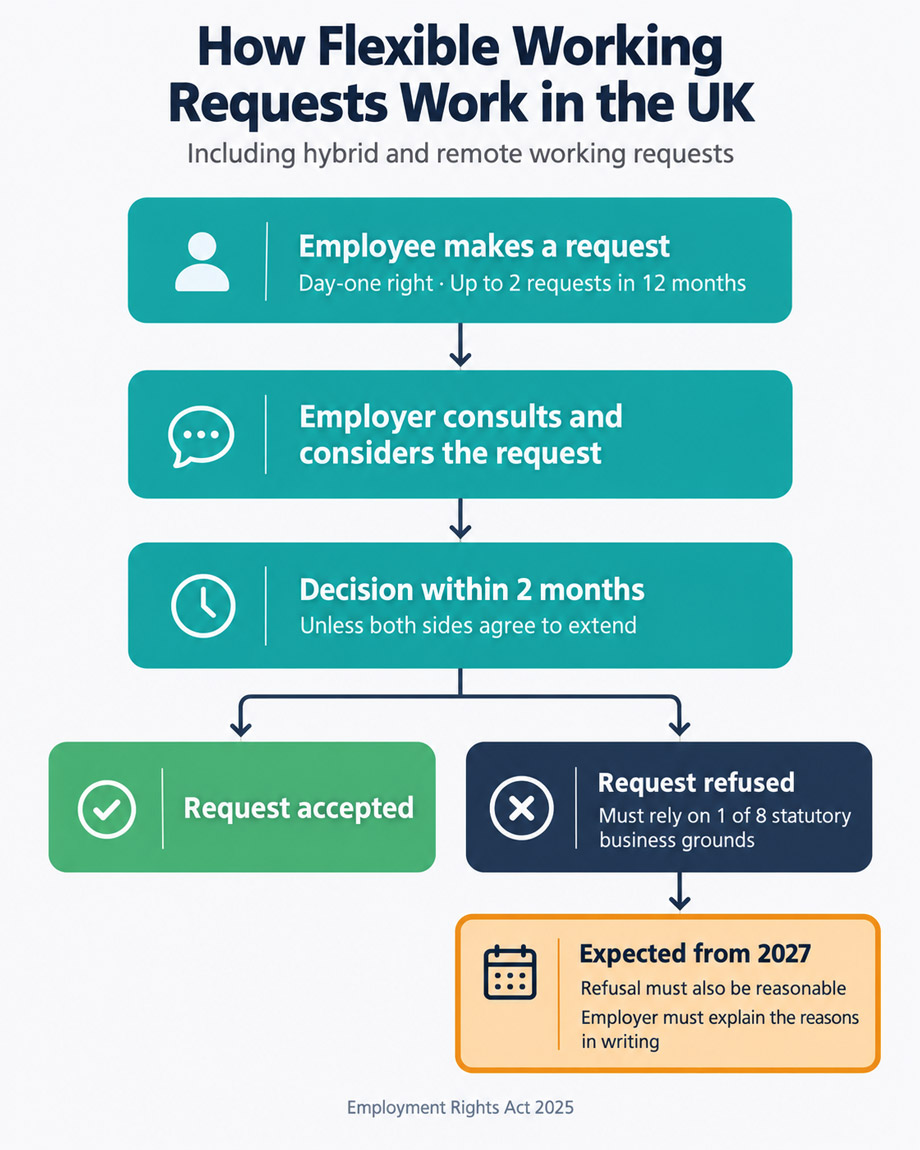
Hybrid arrangements are often agreed informally, but the legal framework behind them is tightening, and businesses should plan for it now.
Since April 2024, employees have been able to request flexible working from their first day in a job. They can make two requests in any 12-month period, and employers must respond within two months unless both sides agree otherwise. A request to change where someone works, including a move to hybrid or remote working, falls within this regime.
Employers can currently refuse a request on one or more of eight statutory business grounds, such as additional costs, an inability to meet customer demand or a detrimental effect on performance. The Employment Rights Act 2025 keeps those eight grounds but adds a further test, expected to come into force in 2027: a refusal will also have to be reasonable. Employers will need to explain in writing which ground applies and why refusing on that basis is reasonable, and employment tribunals will be able to examine that reasoning.
In practice, this rewards the approach set out in the rest of this guide. A business that has already worked out which tasks genuinely need physical presence will find it far easier to justify its decisions than one relying on a blanket rule. Reviewing your flexible working policy and training managers who handle requests are sensible steps to take before the changes commence. For decisions about individual cases, take professional legal advice.
Where Is Hybrid Work Heading Next?
Hybrid work in the UK is becoming more deliberate than the improvised arrangements many businesses adopted during the pandemic.
From “where people work” to “why they work there”
A mature hybrid model starts by asking which work benefits from being together. Workshops, onboarding, coaching, problem-solving and relationship building are often more effective in person, while focused individual tasks can usually be done elsewhere.
This changes the conversation. Instead of asking how many days employees should be in the office, businesses can ask what each office day is supposed to deliver. When attendance is tied to a clear purpose, office time tends to feel more valuable to the people commuting in.
A generation that started work in a hybrid world
Many employees began their careers during or after the pandemic and have built relationships and skills without spending most of their week in an office. For employers, that makes structured development and deliberate social connection more important. Hybrid work is not just a location policy; it shapes how people learn and progress.
What Does Hybrid Work Mean for Managers and Performance?
Measure outcomes, not presence
Someone at a desk for eight hours does not automatically create more value than someone working remotely. Businesses should define measurable outcomes for each role, such as project delivery, quality, deadlines, sales performance or service levels.
Manage through clarity, not monitoring
Hybrid teams need clear priorities, visible responsibilities and agreed ways of collaborating. Managers also need to watch for proximity bias, where people who are physically present unintentionally receive more attention, information or development opportunities than remote colleagues.
Flexibility supports recruitment, but it is not everything
Flexible work can widen the talent pool to people who cannot or will not commute daily. However, pay, management quality, progression, workload and culture still decide whether people stay.
How Should Businesses Decide How Much Office Time They Need?
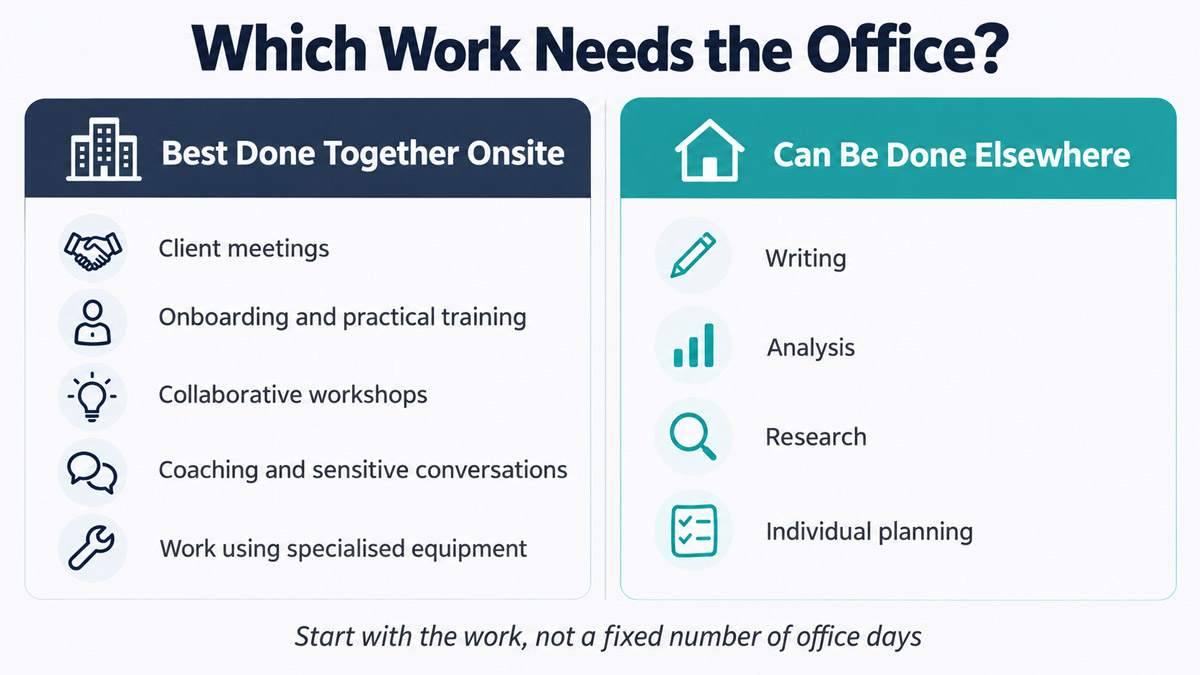
There is no universally correct number of office days. Start with the work instead.
Ask which activities genuinely require physical presence. Client meetings, practical training, sensitive conversations, collaborative workshops and work involving specialised equipment may justify time onsite. Writing, analysis, research and individual planning often do not. Then give shared office days a purpose, for example planning, coaching and creative sessions, rather than asking everyone to commute only to spend the day on video calls.
Different roles will also need different arrangements:
| Role type | Potential hybrid considerations |
|---|---|
| Marketing | Remote focus work, with in-person workshops and campaign planning |
| Sales | Flexible location for client work, with office time for coaching and coordination |
| IT | Depends on security, infrastructure and equipment requirements |
| Operations | More onsite presence where physical processes are involved |
The principle is consistent, well-reasoned decision-making, not identical schedules. That consistency also matters if a flexible working request is ever challenged.
How Technology Will Shape the Hybrid Workplace
Technology makes distributed work practical, but more software does not automatically create a better hybrid workplace.
Most hybrid organisations need dependable video meetings, messaging, document collaboration, cloud access and secure communication, along with suitable devices and connectivity for each role. Working across homes and shared spaces also increases data protection risk, from unsecured home networks to employee monitoring tools, so policies should reflect your obligations under UK GDPR.
A common weakness is that people in the meeting room get a better experience than those dialling in. Good room technology, clear meeting habits and shared access to information help close that gap, so the working experience is consistent regardless of location.
AI is likely to extend what hybrid teams can do through meeting summaries, knowledge retrieval and workflow automation. The value will come from applying these tools to real workflow problems, not from adopting them because they are new.
What Happens to the Office in a Hybrid Future?
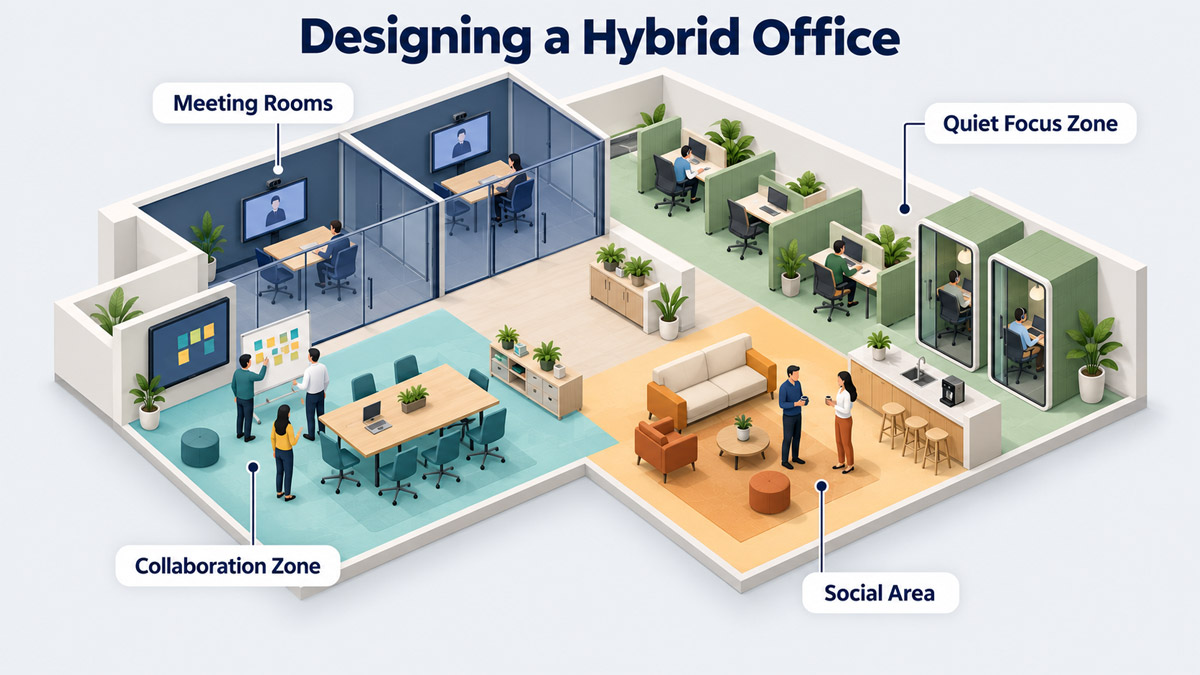
Hybrid working does not make the office irrelevant. It changes what the office needs to do.
If employees spend fewer days onsite, rows of permanent desks may no longer reflect how space is used, and more emphasis may shift to meeting rooms, project spaces and social areas. But not everyone comes in to socialise. Some people use the office because home is distracting or unsuitable for concentrated work, so a well-designed hybrid office should support quiet individual work as well as collaboration.
Lower attendance does not automatically mean cutting space immediately. Base that decision on actual usage data, workforce plans and meeting requirements, and ask whether the workplace suits how the organisation works now.
Common Hybrid Working Mistakes to Avoid
- Using one schedule for every role: Different jobs have different location needs.
- Requiring attendance without a clear purpose: People value office time more when they understand why they are there.
- Measuring visibility instead of outcomes: Being seen is not a reliable measure of contribution.
- Overlooking career development: Remote employees need comparable access to feedback, coaching and progression.
- Handling requests inconsistently: Ad hoc decisions on flexible working will be harder to defend once the reasonableness test applies.
A Practical Framework for a Future-Ready Hybrid Model
- Identify which work requires presence. Separate tasks that benefit from being onsite from those that do not.
- Define the purpose of office days. Link attendance to collaboration, learning or customer needs.
- Set clear expectations. Make responsibilities, communication standards and availability easy to understand.
- Equip employees consistently. Provide the technology, access and security support needed across locations.
- Update your flexible working policy. Document your reasoning and prepare managers for the 2027 changes.
- Measure and review. Track performance and employee feedback, and adjust as needs change.
Frequently Asked Questions About Hybrid Work in the UK
Do employees have a legal right to hybrid working?
No. Employees have a day-one right to request flexible working, including hybrid arrangements, but not an automatic right to have the request granted. Employers can refuse on one of eight business grounds, and from 2027 the refusal will also need to be reasonable.
How many days should employees work from the office?
There is no universal answer. Base attendance on the nature of the work, team and customer needs, and the purpose of being onsite.
Is hybrid work better than fully remote work?
Neither is automatically better. Hybrid work keeps opportunities for in-person collaboration, while fully remote models offer more geographic freedom. The right choice depends on how the organisation operates.
Will offices still be needed in the future?
For many organisations, yes, but the office is likely to become a place for collaboration, learning, connection and focused work rather than the default location for every task.
Conclusion: Purpose, Not Just Place
The future of hybrid work in the UK is unlikely to be defined by one fixed office schedule. The stronger approach is to match people, technology, space and types of work deliberately, and to be able to explain those choices clearly as flexible working law tightens.
The practical next step is to stop asking only how often employees should come in and start asking what the office, home and other working locations each need to achieve. That shift creates a hybrid model that is clearer for employees, more useful for managers and better aligned with business goals.
