
An AI subscription might cost less than a team lunch. Getting a business to use that technology properly can cost considerably more.
That is why the advertised price of an AI tool rarely tells the whole story. For a small UK business, the real AI adoption cost can include software, setup, employee time, training, integrations, maintenance and the cost of mistakes. In some cases, the technology itself is the smallest part of the investment.
Understanding those costs makes it easier to decide whether a simple subscription is enough, whether a workflow should be automated, or whether a larger implementation is justified.
How Much Does AI Adoption Cost for a Small UK Business?
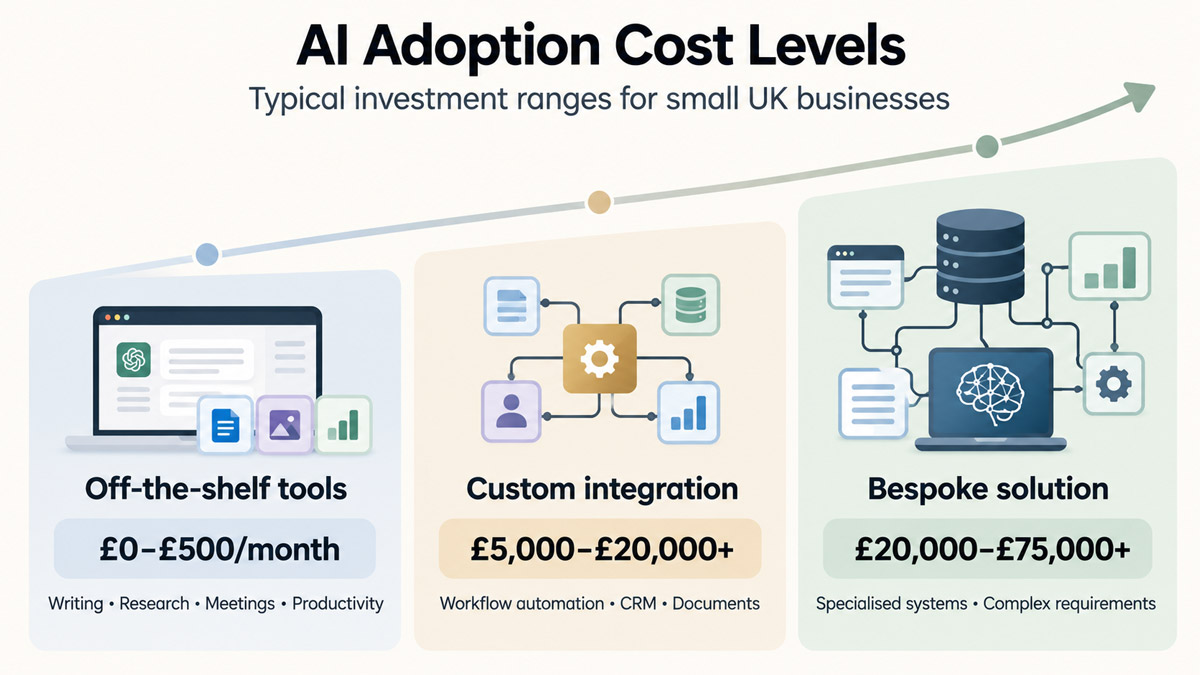
There is no single price, because “AI adoption” can mean anything from giving employees a writing assistant to building a system that connects customer data, internal software and automated workflows. The table below sets out realistic planning ranges, not fixed market prices.
| Approach | Typical cost | Best suited to | Main trade-off |
|---|---|---|---|
| Off-the-shelf tools | £0–£500 per month | Writing, research, meetings, support and everyday productivity | Fast to test and easy to change, but limited customisation |
| Custom integration | £5,000–£20,000+ | Automating a specific business workflow | Fits existing systems well, but adds setup and maintenance overhead |
| Bespoke solution | £20,000–£75,000+ | Complex needs or proprietary data that off-the-shelf tools can’t handle | Built around specialised requirements, but carries the greatest complexity and ongoing commitment |
A small business may spend very little on software but much more on implementation and internal time, or spend heavily on development where a simpler approach would have worked just as well.
The Three Layers of AI Cost
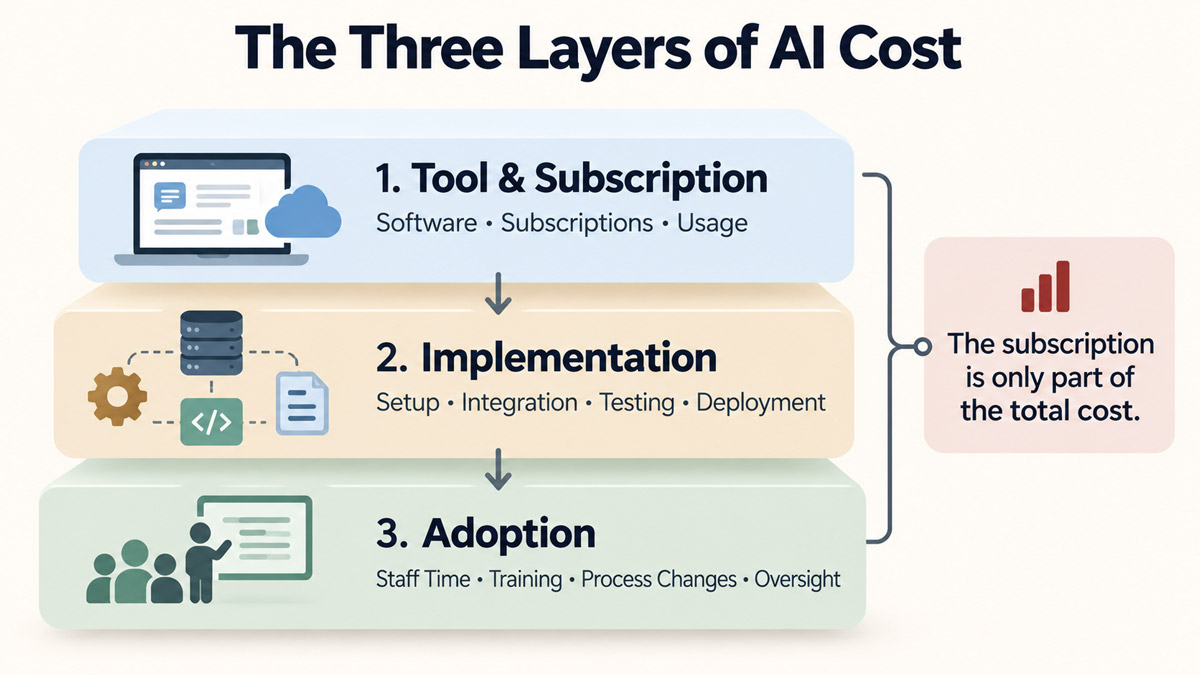
1. Tool and subscription costs
The most visible cost is usually the easiest to understand. Businesses can subscribe to tools for writing, research, customer service, meeting transcription, document processing, design and other common tasks.
A small company might spend £100–£400 a month across several services — often enough to test whether a use case is genuinely valuable before committing to any development.
2. Implementation costs
Costs increase once a business needs AI connected to its existing systems: workflow design, integrations, testing, data preparation, deployment and technical support all add up. An AI tool that drafts customer emails is relatively simple. A system that reads incoming enquiries, checks customer records, categorises the request and prepares a response for approval requires considerably more work — and a narrowly scoped workflow is almost always easier to control than trying to automate an entire department at once.
3. Adoption costs
This is the layer most pricing pages underestimate. Employees need time to learn the system, test outputs, adjust established processes and work out when human review is still necessary. If several people spend hours experimenting with a new workflow, that is a real business cost even though it never appears on a software invoice.
The Hidden Costs Small Businesses Often Miss
Employee time
Someone has to select tools, test them, build processes, monitor results and deal with exceptions. Smaller companies often feel this cost more sharply, because the same people are also responsible for day-to-day operations.
Training and change management
Buying a tool does not guarantee adoption. Employees need clear guidance on what the technology should be used for, what information can safely be entered, and when a human should check the result.
Data preparation and integration
Existing business data is often inconsistent, incomplete or spread across several systems, and connecting those systems can take considerably more work than expected.
Ongoing usage and maintenance
Projects can create recurring costs through subscriptions, API usage, hosting, support, maintenance and updates. A system that costs £10,000 to build may still need a meaningful annual budget to stay reliable.
The cost of mistakes
An incorrect answer can create rework. A bad document extraction can create accounting problems. An inaccurate customer response can damage trust. For that reason, the cheapest setup is not always the lowest-cost option — human review may add a small operational cost while preventing much larger ones.
A Realistic First-Year Cost Example
Consider a ten-person business that wants to improve internal productivity and automate one administrative workflow. Its first-year budget might include several hundred pounds a month for software, an initial setup or integration project, employee time for testing, training during rollout and an ongoing allowance for maintenance.
The important point is not the exact total but the structure of the calculation. A company weighing up a £10,000 implementation should not compare that figure only against a £100 monthly subscription — it should compare the total first-year investment with the measurable value the new process is expected to create.
How to Work Out Whether AI Is Worth the Cost
Start with the business problem
Do not begin by asking which technology to buy. Begin with a process that is repetitive, time-consuming, expensive or prone to avoidable errors — a clearly defined problem gives you something measurable to improve.
Estimate the value of the time saved
Suppose a process takes 80 staff hours each month. If a new workflow safely reduces that by 30 hours, those 30 hours represent potential economic value — one that should be weighed against subscription, implementation and maintenance costs, rather than treated as a vague productivity benefit.
Calculate a simple payback period
A useful starting formula is:
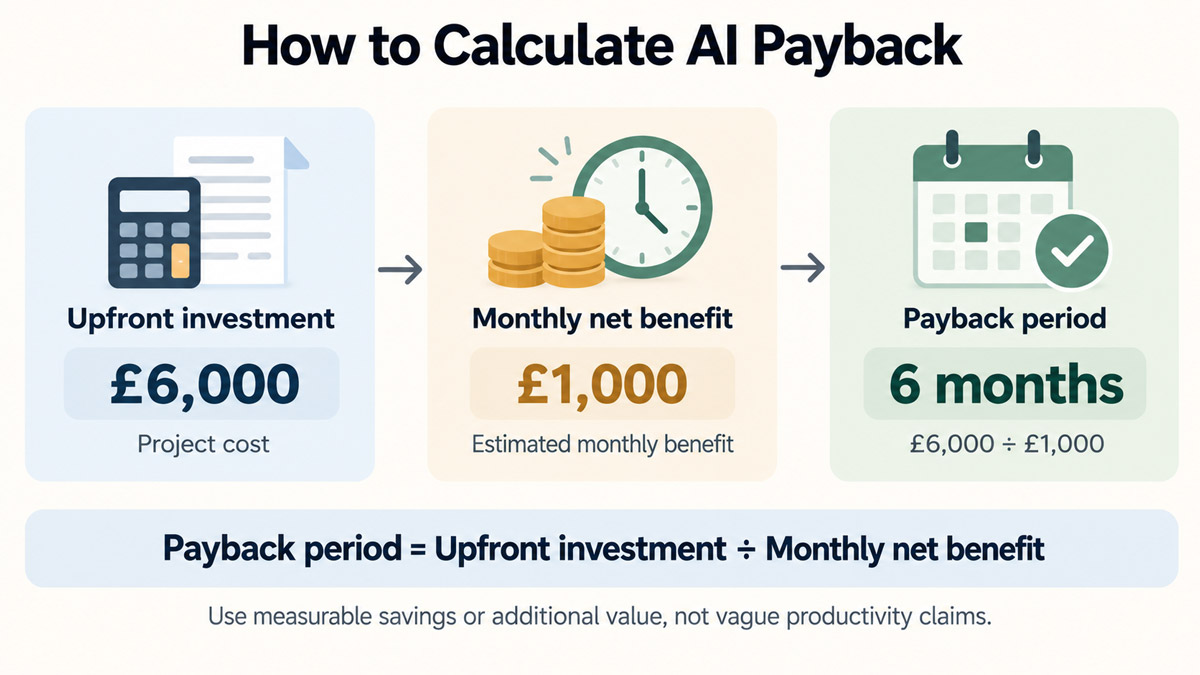
Payback period = upfront investment ÷ monthly net benefit
A £6,000 project producing a genuine £1,000 monthly net benefit would have an estimated six-month payback period. This is only a planning calculation — actual results depend on adoption, reliability, workload and whether the predicted savings are realised.
Know when it is not worth paying for
Not every task needs automation. If a process happens rarely, takes little time or requires constant judgement, the cost and complexity of a solution may outweigh the benefit. A strong adoption strategy includes deciding what not to automate.
Common Mistakes That Push AI Costs Up
- Buying several tools before identifying a specific business problem.
- Building a complex system before testing a simpler version.
- Underestimating employee time and training.
- Comparing supplier quotes that include different amounts of testing, support or development.
- Ignoring recurring usage and maintenance costs.
- Trying to automate processes where human judgement is still essential.
One of the simplest ways to reduce unnecessary spending is to define the desired outcome before choosing the technology.
How Small UK Businesses Can Control AI Costs
Start with a low-cost test using an existing tool, before commissioning custom development. Then measure the result — hours saved, response times, processing volume, error rates or another metric that matters to the business.
If the result is strong, expand in stages. This reduces the risk of committing a large budget to an unproven workflow. When comparing suppliers, ask for costs to be broken down into discovery, development, testing, deployment, training and ongoing support — two quotes with very different totals may simply cover different scopes.
It is also worth checking whether any UK grants, support programmes or tax reliefs apply to the business’s specific circumstances. These are conditional, so they should be treated as potential sources of support rather than a guaranteed reduction in project cost.
What Current UK AI Adoption Data Tells Small Businesses
AI adoption is growing, but adoption is not the same as transformation.
The Department for Science, Innovation and Technology’s most recent Business Data Survey (fieldwork completed January 2026) found that 41% of UK businesses handling digitised data now use AI for at least one purpose — mostly for research or drafting content, not deeper workflow redesign. Other surveys put small-business adoption higher, largely due to looser definitions of “using AI.” Either way, casual tool use remains far more common than AI embedded into core operations.
Smaller businesses also face practical barriers: cost, skills shortages, uncertainty about which tools to use, and concerns about security and governance — particularly how customer data is handled once AI tools are layered onto existing systems. Businesses processing personal data should check how UK data protection rules differ from the EU’s GDPR in practice, since that gap affects what an AI workflow can do with customer information.
That distinction matters when planning cost. A business does not need to jump straight from occasional experimentation to a large custom build. A measured progression from testing to proven workflow improvements is usually far easier to manage financially.
Frequently Asked Questions
How much does AI cost for a small business in the UK?
Basic AI use can cost tens or a few hundred pounds per month. More advanced workflow automation can require several thousand pounds, while bespoke projects can reach tens of thousands. The real total depends on implementation, employee time and ongoing costs as well as software.
Can a small business start using AI for under £100 a month?
Yes. A business can test several common productivity use cases within a relatively small monthly budget. The bigger question is whether employees use the tools consistently and whether they produce measurable value.
What are the ongoing costs after implementation?
Depending on the setup, ongoing costs can include subscriptions, API usage, hosting, maintenance, support, security reviews and periodic improvements.
Is AI worth the investment for a small business?
It depends on the use case. AI is more likely to justify investment when it addresses a frequent, measurable problem and the expected benefit is greater than the full cost of adoption.
What is the biggest hidden cost of AI adoption?
For many small businesses, it is the internal time required to evaluate, implement, supervise and improve new workflows. That cost is easy to overlook because it rarely appears as a separate invoice.
The Real Cost Is the Cost of Adoption
The price of an AI tool is only the starting point. The real business calculation includes technology, implementation, people, ongoing operations and the potential cost of errors.
For a small UK business, the most practical approach is to begin with one clearly defined problem, test the cheapest sensible solution, measure the result and increase investment only when the evidence supports it.
That turns AI from an open-ended technology expense into a business decision that can be evaluated in pounds, hours and measurable outcomes.
