

For many UK workers, artificial intelligence is no longer something that belongs in a presentation about the future. It is already helping write emails, summarise meetings, analyse information and handle routine tasks. The more interesting question in 2026 is not whether it will change work, but which parts of work are changing first.
That distinction matters. A job is rarely automated all at once. More often, individual tasks change, the way teams organise their time changes, and employees are expected to bring a different mix of technical and human skills. It is a point that independent research organisations such as Vorexa keep returning to: the loudest debate is about job numbers, while the most useful evidence sits at the level of daily tasks.
Key points
- AI adoption is becoming a normal part of work for many UK businesses and employees.
- Routine digital tasks are among the first areas to change.
- AI assistants and autonomous AI agents have different implications for workplaces.
- Job roles are more likely to be redesigned than simply eliminated overnight.
- Entry-level workers may face a particular challenge as routine learning tasks become automated.
- AI literacy, judgement, communication and domain expertise are becoming increasingly important.
- Using AI faster does not automatically mean working better.
- Employers need clear policies, training, human oversight and practical measures of productivity.
How AI Is Changing the UK Workplace in 2026
UK businesses are moving from experimentation towards everyday use. The change is particularly visible in office-based work, where large amounts of information can be searched, drafted, summarised or processed digitally.
This does not mean every employee is suddenly working alongside an automated system all day. Adoption varies by industry, company size and role. The important shift is that these tools are increasingly being built into normal workflows rather than treated as a novelty.
Adoption has also tended to run ahead of policy. In plenty of organisations, staff were using these tools competently for months before anyone wrote down what was and was not permitted, which is why so much of the 2026 conversation is about governance catching up rather than about the technology itself arriving.
What Is Actually Changing in Everyday Work?
The clearest way to understand the AI impact on the UK workforce is to look at tasks rather than job titles.
Tasks being automated or accelerated
- Email and document drafting
- Meeting notes and summaries
- Routine research
- Data organisation and analysis
- Administrative work and scheduling
- Customer service enquiries
- Content production and editing
- Software development assistance
Think about the last time you sat through an hour-long meeting and then spent another twenty minutes writing it up. That second part is exactly the kind of work being absorbed first.
Consider a marketing executive who once spent an afternoon turning research into a first draft. With AI assistance, the first version may arrive in minutes. The employee’s value then shifts towards checking facts, improving the message, understanding the audience and deciding what should actually be published.
That is the wider pattern: less time producing the first version, and more responsibility for judgement and quality. The complication is that judgement is far harder to measure than output, which is why some managers underestimate how much a role has genuinely changed even when the job title has not moved at all.
AI Assistants vs AI Agents: Why the Difference Matters
What is an AI assistant?
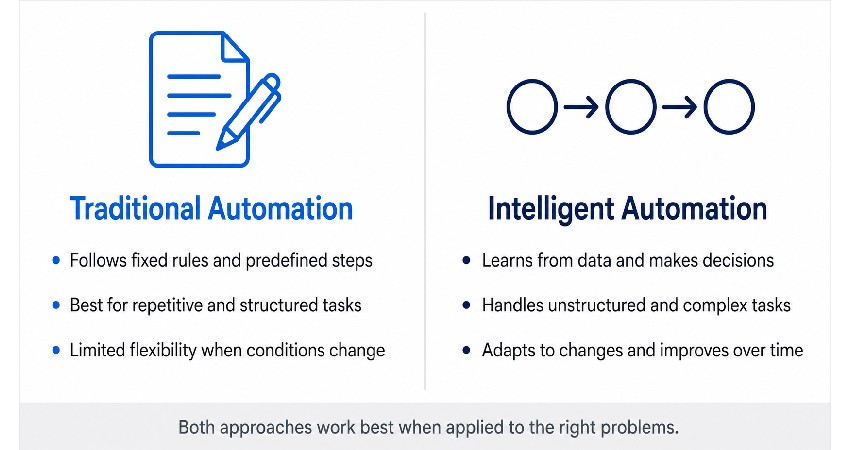
An assistant mainly helps a person. It can generate a draft, summarise a document, suggest ideas or answer questions. The worker remains in control of the final action.
What is an AI agent?
An agent can go further by carrying out tasks, triggering workflows and interacting with other systems. That creates a different level of workplace risk because the system may have access to business information or permission to take actions automatically.
In practical terms, an assistant might draft a reply to a customer. An agent could potentially retrieve information, update a system and start the next step in a workflow. More autonomy means greater importance for permissions, monitoring and accountability.
This is where 2026 looks different from the first wave of adoption. Agent pilots are reportedly spreading fastest in IT support, finance operations and customer service, and each one raises the same three questions before anything else: what can it access, what can it do without asking, and who reviews the record afterwards? Organisations that cannot answer all three tend to find out the hard way that an audit trail is not an optional extra.
Which UK Jobs Are Most Affected?
Roles built around repetitive digital work are generally more exposed than jobs that depend heavily on physical activity, complex relationships or real-world judgement.
| Work type | Likely impact | What changes |
|---|---|---|
| Routine digital work | High | More automation and faster processing |
| Knowledge work | High | More assistance with research, drafting and analysis |
| Relationship-based work | Medium | Technology supports rather than replaces human interaction |
| Physical skilled work | Lower direct impact | Planning, diagnosis and administration may become easier |
| High-accountability decisions | Medium | More analysis, but human responsibility remains important |
Accountancy, marketing, HR, customer service, legal support and software development are examples where individual tasks can change substantially without making the entire profession disappear. The practical test for any role is simple enough: how much of the week is spent moving information around, and how much is spent deciding what to do about it?
What Happens to Entry-Level Jobs?

This is one of the most important workplace questions in 2026. Junior employees often learn by doing routine work: preparing documents, researching basic information, checking spreadsheets and handling straightforward requests.
If technology handles more of those tasks, companies may need to rethink how graduates and new starters gain experience. The risk is not simply fewer entry-level jobs. It is a weaker career ladder if routine work disappears without new ways to learn professional judgement.
It is worth being careful with the causation here, because the headlines rarely are. Early-career hiring in the UK has been under pressure for several reasons at once — subdued growth, higher employment costs, restructuring and a sheer volume of applications per vacancy — and automation is one strand in that picture rather than the whole of it. Generally speaking, the sharpest declines have shown up in information-processing roles, while jobs built around people, persuasion and problem-solving have held up rather better.
There is also a quieter countertrend. As more first drafts arrive machine-made, somebody has to check them, and a new category of junior work is emerging around reviewing, correcting and quality-controlling automated output. It is not the graduate scheme of a decade ago. It is not the disappearance of entry-level work either.
The strongest organisations will not just remove junior tasks. They will redesign them so newer employees can use technology while still developing the skills needed for more complex work.
Which Skills Matter Most in 2026?
The strongest combination is not technical knowledge alone. It is AI literacy plus genuine expertise in a particular field.
Technical skills
- Using workplace AI tools effectively
- Writing clear instructions
- Checking and validating outputs
- Understanding data security
- Automating suitable workflows
Human skills
- Critical thinking
- Judgement
- Leadership
- Communication
- Negotiation
- Relationship management
An employee who understands both the technology and the business problem is often more useful than someone who knows the tools but cannot judge whether the result makes sense. Being able to say “this looks plausible but it is wrong, and here is why” is fast becoming one of the most valuable things a person can do in an office.
Is AI Really Improving Productivity?
Faster work is not automatically better work. A draft produced in thirty seconds still needs checking. A summary can miss an important detail. A spreadsheet analysis can produce a confident-looking answer that is simply wrong.
The most under-counted cost here is rework. Output that looks polished but is subtly wrong usually takes longer to repair than output that is obviously poor, because somebody has to find the error before they can fix it — and time spent tidying up other people’s automated work rarely appears in anyone’s efficiency figures.
Real productivity should therefore be measured through more than speed. Employers should look at time saved, quality, error rates, output and whether the change actually improves a business outcome.
The best question is not “Are employees using AI?” It is “Is the work better because they are using it?”
What Are the Biggest Workplace Risks?
Confidential information
Employees may accidentally enter sensitive business, customer or employee information into tools that have not been approved by their employer. In most cases this is not recklessness so much as convenience under deadline pressure, which is precisely why clear rules work better than warnings.
Accuracy and over-reliance
Workers can become too comfortable accepting generated answers without checking them. This is particularly risky in finance, legal work, recruitment and other areas where mistakes have serious consequences.
Bias and accountability
Automated recommendations can influence hiring, performance decisions or customer interactions. Someone within the organisation still needs to be accountable for the decision.
The legal backdrop moved in early 2026. Reforms under the Data (Use and Access) Act 2025 replaced the older blanket restriction on solely automated decisions with a more permissive framework, provided safeguards are in place: telling people when a significant automated decision has been made about them, and giving them a genuine route to human review and challenge. Decisions resting on special category data remain far more tightly controlled. The practical effect is that UK employers have more room to automate parts of recruitment and performance processes — and correspondingly less excuse for being unable to explain how those decisions were reached. It is also one of the clearer examples of how UK and EU data protection rules now diverge, which matters for any organisation running the same HR process on both sides of the Channel. Data protection is not the only constraint, either. Equality law still applies to the outcome, whoever or whatever produced it.
Unsanctioned tools
When employees use their own preferred tools without organisational oversight, companies can lose visibility over what information is being shared and how systems are being used.
What Should UK Employers Do in 2026?
- Create clear rules: define approved tools, restricted information and situations requiring human review — and be ready to handle data concerns raised internally, since employees can now complain directly to their employer as well as to the regulator.
- Train staff: focus on real workplace tasks rather than generic technology demonstrations. Role-specific training is consistently the gap employers report, and it is the part most often skipped.
- Redesign jobs: decide which tasks should be automated, assisted or kept firmly under human control.
- Measure results: track quality, time saved, errors and business outcomes.
- Prepare for agents: control permissions, monitor activity and make responsibilities clear.
Common Misconceptions About AI and UK Jobs
“AI will replace whole jobs overnight.”
Most workplace change happens task by task. A role may become significantly different without disappearing completely.
“AI cannot replace human work.”
That is equally misleading. Routine and repetitive work can already be automated or accelerated, particularly when it is digital and rules-based.
“Using AI automatically makes someone productive.”
Only when the output is accurate, useful and integrated into a sensible workflow.
What Will the UK Workplace Look Like Next?
The workplace of 2026 is not simply one with fewer people. It is one where the boundaries between employee work and machine-assisted work are becoming less obvious.
Some tasks will disappear, others will become faster, and new responsibilities will emerge around checking, directing and improving automated work. The biggest advantage is likely to go to organisations that redesign workflows rather than simply bolt new tools onto old processes.
Frequently Asked Questions
How is AI changing the UK workplace in 2026?
It is changing how employees complete routine digital tasks, analyse information, communicate, recruit and organise work. The biggest change is often task redesign rather than immediate job replacement.
Which UK jobs are most affected by AI?
Jobs containing significant amounts of repetitive digital work are more exposed. Administration, marketing, customer service, finance, HR, legal support and software development can all see substantial task-level change.
Will AI replace jobs in the UK?
Some tasks and roles will be automated, but the overall effect varies by occupation. Many jobs are more likely to be reshaped, with employees spending less time on routine work and more on judgement, communication and oversight.
What skills will be most valuable?
AI literacy will matter, but so will critical thinking, communication, leadership, domain expertise and the ability to judge whether an automated result is correct.
Will AI reduce entry-level jobs?
It could reduce some routine junior tasks, creating a challenge for traditional career paths. Employers may need to redesign early-career roles so people can still develop practical experience. Wider economic conditions are also part of the pressure on graduate hiring, so automation is rarely the only factor at work.
Should UK employers have an AI policy?
A clear policy can set expectations around approved tools, confidential information, human review, accountability and responsible use. Since the 2026 changes to UK data protection rules on automated decision-making, being able to evidence those safeguards matters as much as having them.
Conclusion
How AI is changing the UK workplace in 2026 is less about a sudden takeover and more about a steady reshaping of how work gets done. Routine digital tasks are moving faster, job descriptions are evolving and the value of human judgement is becoming clearer.
The real dividing line will not be between people who use AI and people who do not. It will be between workplaces that use it thoughtfully and those that use it without changing the way work is designed.
