

The most common compliance mistake in 2026 is treating every regulatory development as either “already law” or “something to worry about later”. Some duties took effect this year. Some are still moving through Parliament. Others are policy signals that shape contracts and procurement long before they shape statute.
That distinction matters because one business using cloud services, customer data, an online platform or artificial intelligence can sit inside several regimes at once. Here are the developments worth tracking, and what each actually requires.
The UK Technology Regulations to Watch in 2026 at a Glance
| Regulation or development | Position in September 2026 | Businesses most affected | Main issue |
|---|---|---|---|
| Cyber Security and Resilience Bill | In the House of Lords; Royal Assent expected late 2026 | Essential services, managed service providers, data centres, critical suppliers | Cyber resilience and incident reporting |
| Data (Use and Access) Act 2025 complaints duty | In force since 19 June 2026 | Every organisation handling personal data | Data protection complaint handling |
| Crime and Policing Act 2026 online safety duties | Enacted April 2026 | Regulated user-to-user and search services | Intimate image takedown and new offences |
| Digital Markets, Competition and Consumers Act 2024 | Active; subscription rules from January 2027 | Large digital firms and any business selling to consumers | Digital competition and fair consumer practices |
| UK artificial intelligence regulation | Sector-led; no dedicated statute | Businesses developing or deploying AI | Existing obligations and governance |
| Digital Standards Strategy | 2026–2030 strategy | Technology suppliers and buyers | Security, interoperability and market access |
Cyber Security and Resilience Bill
This is the most significant area to watch, because the Bill would bring a far wider set of technology providers into the UK’s resilience regime for the first time.
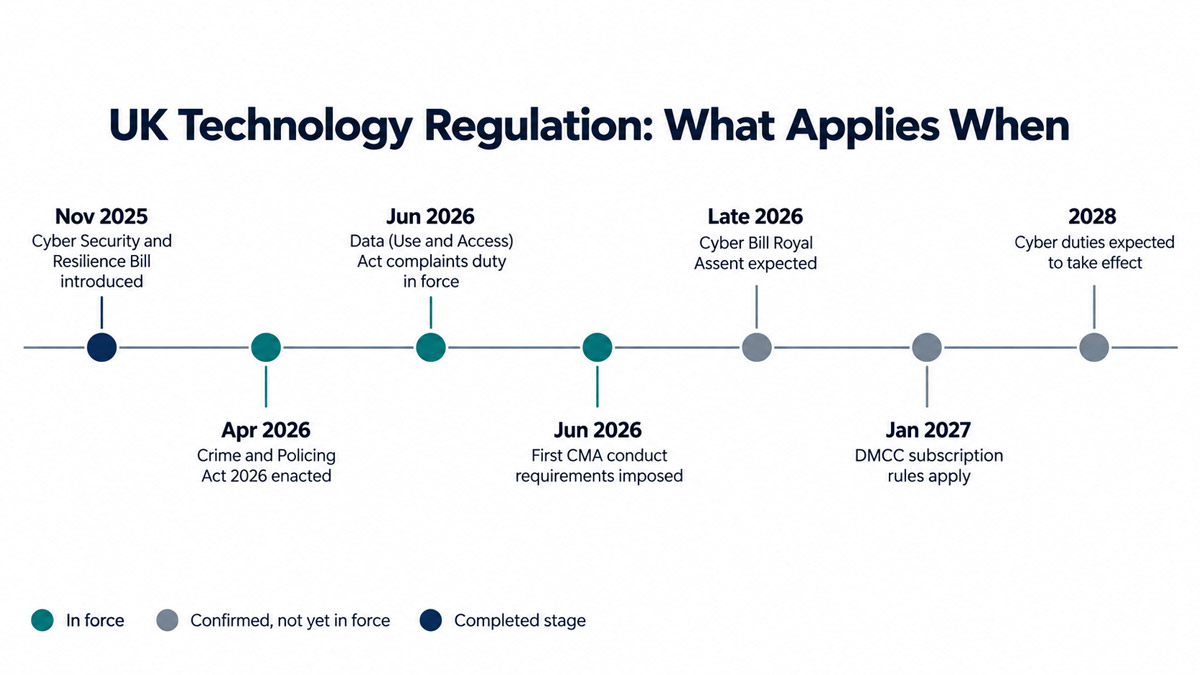
Introduced in November 2025, the Cyber Security and Resilience (Network and Information Systems) Bill completed its Commons stages in June 2026 and is now in the House of Lords, where committee scrutiny began on 1 September 2026. It amends the NIS Regulations 2018 rather than replacing them, bringing medium and large managed service providers, data centres and designated critical suppliers into scope, tightening incident reporting and strengthening regulator powers.
Who should pay attention
Chiefly businesses providing managed IT, hosting or digital infrastructure, and organisations supporting essential sectors such as energy, water and healthcare. Companies outside direct scope will often feel it anyway, through the security clauses their regulated customers start writing into contracts.
What businesses should prepare for
- Map critical systems, data flows and third-party dependencies.
- Test incident-response procedures against tighter reporting deadlines.
- Review supplier and outsourcing arrangements for cyber risk.
- Record how security risks are identified and managed.
Timing is what trips businesses up. Royal Assent is expected in late 2026, but the operational detail arrives through secondary legislation and consultation, so substantive obligations are not expected to bite until closer to 2028. Prepare on that basis rather than assuming every proposal is enforceable today.
Data Protection and Complaint-Handling Requirements
The clearest change of 2026 is already live. On 19 June 2026 the final provisions of the Data (Use and Access) Act 2025 came into force, including a statutory duty on controllers to handle data protection complaints directly.
Organisations must give people a clear route to complain, acknowledge a complaint within 30 days, investigate appropriately and communicate the outcome along with the right to escalate to the Information Commissioner’s Office. The ICO has been explicit that there are no exemptions, regardless of size or sector. Because the DUAA amends rather than replaces the UK GDPR, this sits on top of existing obligations — and the practical differences between the UK and EU data protection regimes still matter for anyone processing personal data on both sides of the Channel.
What businesses should review
- How customers and employees can complain, including through informal channels such as social media.
- Who owns the complaint, how it is escalated, and how decisions and timings are recorded.
- Whether privacy notices explain the right to complain.
It is a useful reminder that technology compliance is not an IT problem. One privacy complaint can involve customer service, HR, legal and operations at once.
Artificial Intelligence: What UK Businesses Actually Need to Watch
There is still no single UK artificial intelligence statute and no AI bill before Parliament. The government has stayed with a sector-led approach: in January 2026 ministers asked regulators to publish plans for enabling safe AI innovation, and the King’s Speech in May 2026 announced a Regulating for Growth Bill creating sandbox powers, including the AI Growth Lab, rather than a general AI rulebook.
So AI is regulated through the rules you already have. A company using software to shortlist job applicants must still consider what personal data is processed, whether decisions are meaningfully reviewed, whether candidates are treated fairly under equality law, and what evidence explains the outcome. Treating the system as a supplier’s black box does not transfer that responsibility.
Do UK businesses need to watch EU rules?
Yes, where their activities bring them within European scope. A UK company serving EU customers or placing products on the EU market can face obligations under the EU AI Act and EU data protection law that do not follow from UK incorporation. Assess where your customers, operations and infrastructure actually sit.
Online Safety Duties for Digital Platforms
The Crime and Policing Act 2026, which received Royal Assent on 29 April 2026, extended the Online Safety Act. Regulated user-to-user and search services must remove reported non-consensual intimate image content as soon as reasonably practicable and within 48 hours, and the Act creates new offences covering “nudification” tools and non-consensual intimate images.
Two points deserve attention. Personal criminal liability now attaches to failures to comply with certain Ofcom confirmation decisions, which moves online safety onto the board agenda. And scope is functional rather than sectoral: any service hosting user content or enabling user-to-user communication should check whether it is caught. Reporting routes and escalation paths need to work as operational controls, not policies filed away.
Digital Markets, Competition and Consumer Protection
The Digital Markets, Competition and Consumers Act matters for two separate reasons.
The digital markets regime applies only to firms designated with Strategic Market Status, and it is now visibly active. Google was designated for general search and search advertising in October 2025, alongside Apple and Google for their mobile platforms. In June 2026 the Competition and Markets Authority imposed its first conduct requirements on Google, covering publisher control, fair ranking and search data portability, and a fourth investigation into Microsoft’s business software is under way.
The consumer side reaches much further. Rules on drip pricing, fake reviews and other unfair practices are already enforceable, backed by the CMA’s direct enforcement powers. The subscription contracts regime is not: after two delays it was set for spring 2027, then brought forward to January 2027, with secondary legislation and guidance still to come. Any business running free trials or auto-renewals should map cancellation journeys and renewal notices now rather than wait for the final text.
The UK Digital Standards Strategy
The Digital Standards Strategy for 2026 to 2030 is policy rather than legislation, setting out the government’s approach to international technical standards across artificial intelligence, cybersecurity, advanced connectivity, quantum technologies and semiconductors.
Most such standards are voluntary, but they become commercially significant once they appear in procurement questionnaires, customer contracts, insurance requirements or regulatory guidance. Ignoring them rarely breaks the law; it more often shows up as a lost tender or a failed supplier assessment.
What UK Businesses Should Do Now
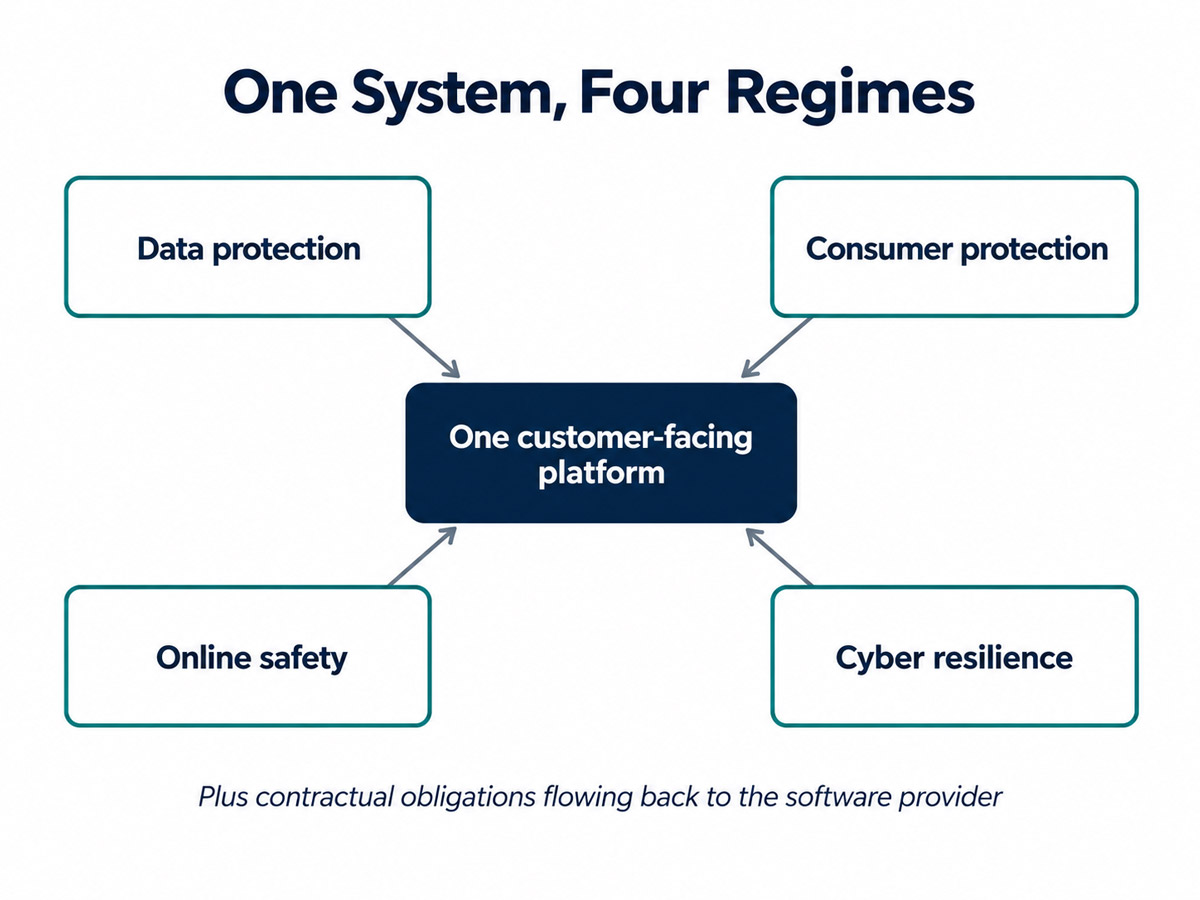
The hardest problems come from several regimes landing on one system: a customer-facing platform can raise consumer protection, data protection, online safety and cybersecurity questions at once. Reviews work better when they start with the technology, not the statute book.
- Map the technology you use. List the systems handling customer data, payments, communications, AI and critical operations.
- Identify which rules apply. Consider your sector, customers, suppliers, geographic reach and position in the supply chain.
- Separate law from policy. Record whether each item is in force, confirmed, proposed or voluntary, and note when that changes.
- Audit the controls. Check incident response, supplier risk, complaints handling, consumer journeys and governance.
- Assign ownership. Give every requirement a named owner and a review date so the work survives the first audit.
Common Mistakes
- Assuming every announcement is already law — or that nothing applies until a Bill passes.
- Treating data protection as the only technology compliance issue.
- Leaving technology risk entirely with the IT team.
- Overlooking suppliers and managed service providers, and failing to record how decisions were reached.
Frequently Asked Questions
Is artificial intelligence regulated in the UK in 2026?
Yes, but not by a dedicated AI statute. Obligations come from data protection, equality, consumer and sector-specific law, applied according to how the technology is used.
Does the EU AI Act apply to UK businesses?
It can, depending on where products and services are supplied and who uses them. UK incorporation does not remove European obligations.
What cybersecurity changes should businesses prepare for?
The Cyber Security and Resilience Bill, particularly for managed service providers, data centres and critical suppliers. Royal Assent is expected in late 2026, with detailed duties following through secondary legislation.
Do small businesses need to worry about all of this?
Not all of it, but more than many assume. The complaints duty applies to every organisation handling personal data, while cyber resilience and digital markets rules are far narrower.
Conclusion
The defining feature of UK technology compliance in 2026 is not a single new law. It is the number of separate regimes now touching the same systems, suppliers and processes.
The workable response is to stop reading regulation as a list of headlines. Establish what your business does, confirm what is enforceable today, prepare for changes already scheduled, and monitor the rest. That list is shorter than the news cycle suggests, and considerably more useful.
