
A business can hold more data than it has ever had and still make poor decisions. The gap is rarely the amount collected. It is whether anyone turns the right data into a better action.
That is why data-driven decision making has moved from a reporting function to a core part of how companies operate. Instead of relying on habit or instinct alone, businesses use evidence to establish what is happening, where the opportunities are, and what to do next — then check whether the decision worked.
What Data-Driven Decision Making Actually Means
Data-driven decision making means using relevant business data to guide a decision rather than relying only on opinion or past experience. The aim is not to let numbers decide everything. It is to make sure people decide with stronger evidence in front of them.
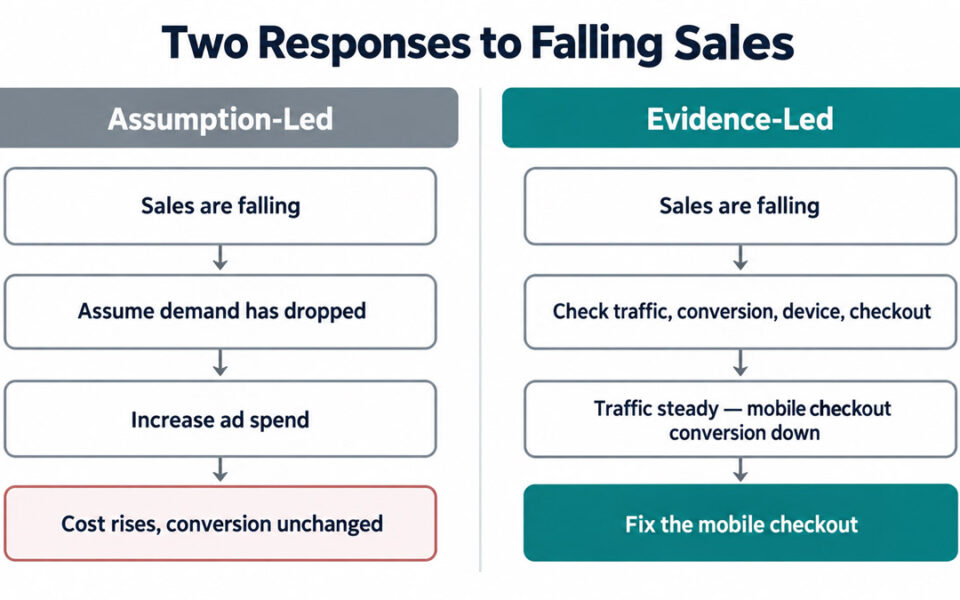
Take an online retailer with falling sales. The instinctive response is to spend more on advertising, on the assumption that demand has softened. A data-driven response looks first at traffic, conversion rates, customer segments, device usage, product performance and checkout behaviour.
The analysis might show traffic holding steady while mobile checkout conversions have dropped sharply. That points to an entirely different action — and a cheaper one. Fixing the mobile buying experience will recover more revenue than buying additional traffic that fails at the same step.
That is the practical difference: moving from “what do we think is happening?” to “what does the evidence show, and what should we do about it?”
How the Process Works
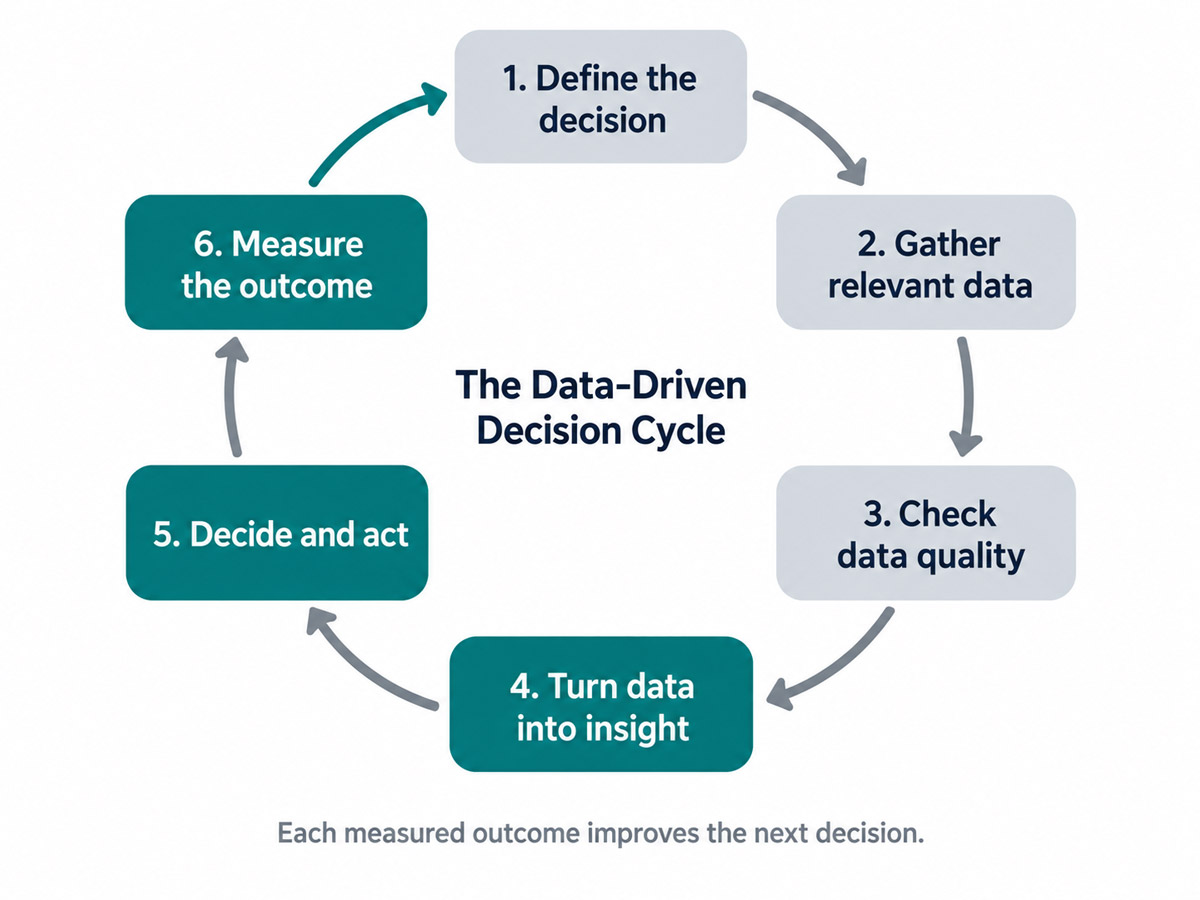
Data-driven decision making is a cycle, not a single step. Six stages connect a clear question to a measured outcome.
1. Start with the decision, not the data
Useful questions are specific: why are repeat purchases declining? Which marketing channel brings in customers who stay? How much stock should we order next month? Without that starting point, teams collect information that never changes anything.
2. Gather the data that matters
Sales transactions, customer interactions, website activity, financial systems, operational records, surveys and market data all have a role. Relevance beats volume.
3. Check quality before trusting it
Incomplete, duplicated, outdated or inconsistent records produce confident conclusions that happen to be wrong. The test is not whether the data is perfect, but whether it is accurate enough for the decision being made.
4. Turn data into insight
Analysis works at four levels:
- Descriptive: What happened?
- Diagnostic: Why did it happen?
- Predictive: What is likely to happen next?
- Prescriptive: What action is likely to produce the best result?
5. Decide and act
Insight creates value only when someone acts on it. Evidence sits alongside business goals, constraints, risk and customer needs — it informs the decision rather than replacing it.
6. Measure what happened
Compare the actual result against the expected one using a KPI defined in advance. This feedback loop is the stage most often skipped, and it is the stage that makes the next decision better.
What Is Actually Changing
Decisions happen closer to real time
Businesses once worked from periodic reports that could be out of date before they reached the people who needed them. Teams now monitor key signals continuously: an operations team can watch stock draining while a campaign is still running, rather than discovering the shortfall in the month-end review. Speed alone does not guarantee a better call, but it buys time to respond.
Forecasting improves and risk surfaces earlier
Historical patterns are difficult to spot through intuition and straightforward to model — demand, cash flow, staffing, seasonal swings. The same data flags anomalies. A sudden shift in cancellations, purchasing or payment behaviour is often the first sign of a problem that becomes far more expensive if left another quarter.
Customer experience becomes more specific
Behavioural and engagement data lets businesses separate audiences that genuinely behave differently instead of treating them as one group. Recommendations, messaging, promotions and retention work can then be aimed at the customers most likely to respond, which improves both the experience and the efficiency of the marketing spend.
Resources are allocated on evidence
A retailer uses demand patterns to rebalance inventory. A service business schedules staff around workload data. A manufacturer traces recurring bottlenecks through production records. Different problems, same move: connecting operational evidence to a specific decision.
Strategy becomes testable
Rather than concluding that a strategy “seems to be working”, leaders can set success metrics upfront and evaluate against them. Strategy shifts from an occasional review into something tested and adjusted continuously.
Where It Applies Across a Business
| Business Area | Data Used | Decision Improved |
|---|---|---|
| Marketing | Conversion rates, customer behaviour, campaign performance | Where to focus budget |
| Sales | Pipeline activity, win rates, deal history | Which opportunities deserve priority |
| Finance | Cash flow, revenue, margins, expenses | Where to control costs or adjust forecasts |
| Operations | Demand, inventory, production, delivery data | How to allocate stock and resources |
| Customer service | Support volumes, response times, feedback | Which service problems to fix first |
None of this belongs solely to a specialist analytics team. The same discipline applies to routine decisions in almost every function.
Analytics and AI: What the Tools Can and Cannot Do
Modern tooling has pushed most businesses well past basic reporting. Forecasting models estimate demand, anomaly detection surfaces activity nobody would find manually, and AI assistants increasingly let non-specialists query data in plain language instead of waiting on an analyst.
None of that is decision making. A sophisticated model cannot rescue a vague business question, unreliable inputs or an undefined objective — it will produce a confident answer to the wrong problem, faster. Automation raises the cost of poor data quality rather than removing it. The strongest results come when technology supports a well-designed decision process instead of standing in for one.
What a Business Needs to Get There
Reliable, accessible data
People need trustworthy figures at the moment they are deciding. When teams arrive with conflicting numbers, the meeting becomes an argument about whose report is correct rather than about what to do.
Data literacy
Nobody needs to become a data scientist. They do need to read a basic metric, question an odd result, recognise the limits of a small sample, and resist drawing firm conclusions from weak evidence.
Governance and lawful use
Clear rules for quality, access, security, ownership and privacy make data dependable without making it unusable. For UK businesses handling customer data, that includes knowing which regime applies — the practical differences between UK GDPR and EU GDPR matter to any organisation processing personal data on both sides of the Channel.
A culture that can be contradicted
Leaders determine whether evidence is genuinely welcome. If analysis that contradicts a senior view is quietly shelved, people quickly learn to produce numbers that confirm decisions already made.
Where Data-Driven Decisions Fail
- Measuring everything: tracking hundreds of metrics buries the handful that actually drive the decision.
- Trusting poor-quality data: a confident conclusion built on incorrect inputs is still wrong.
- Building dashboards instead of making decisions: a dashboard earns its place only when someone acts differently because of it.
- Ignoring context: a metric can show what happened without explaining why.
- Stopping at implementation: without measuring the outcome, nobody learns whether the decision worked.
Being Data-Driven Is Not the Same as Being Data-Only
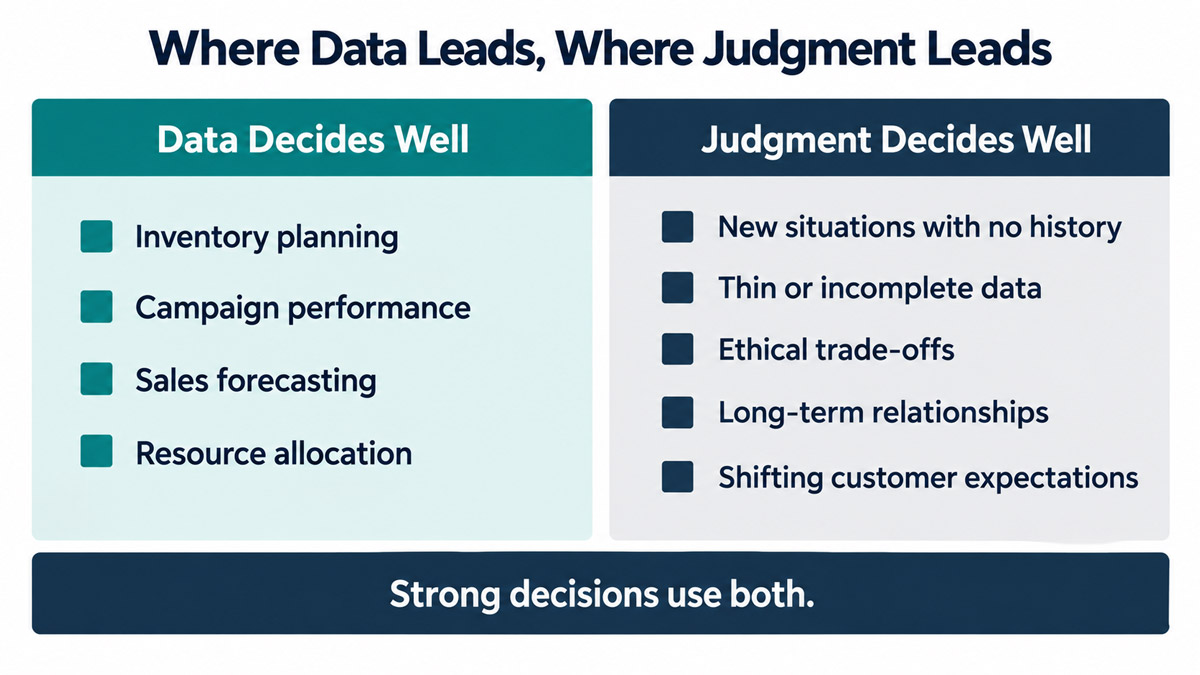
Data earns its place where decisions are measurable, repeatable and supported by reliable history — inventory planning, campaign performance, forecasting, resource allocation.
Judgment matters more when the situation is genuinely new, the data is thin, or the decision turns on factors that resist measurement: ethics, long-term relationships, reputation, shifting customer expectations. Data describes what is happening and what is likely to happen next. People decide what matters.
How to Start
- Choose one decision that matters. Pick a problem with measurable business impact.
- Define success first. Name the KPI you are trying to move before opening the data.
- Use what you already have. Existing sales, finance and website data usually answers more than expected. Buying a platform before defining the problem rarely helps.
- Test the assumption. Look for what the evidence confirms, contradicts, or leaves genuinely uncertain.
- Measure the result. Record what happened and carry it into the next decision.
One well-measured decision does more for a data culture than a company-wide transformation programme.
FAQs About Data-Driven Decision Making
Why is data-driven decision making important for modern businesses?
It supports better-informed choices, faster responses to change, earlier detection of risk, and a clearer view of whether a strategy is producing the results expected of it.
Can small businesses use data-driven decision making?
Yes. Sales trends, retention, conversion rates, costs and cash flow are enough to start. The constraint is usually the quality of the question, not the size of the technology budget.
Does it replace human judgment?
No. Data supplies evidence. People interpret it, weigh the trade-offs, apply context and decide which action best serves the business.
Conclusion
The real change is not that businesses hold more information. It is that they can build a disciplined link between evidence and action — asking better questions, testing assumptions, acting on what the data shows, then measuring what followed.
The practical next step is narrow: pick one important decision, identify the evidence that would improve it, and measure the outcome. That is where being genuinely data-driven begins.
