

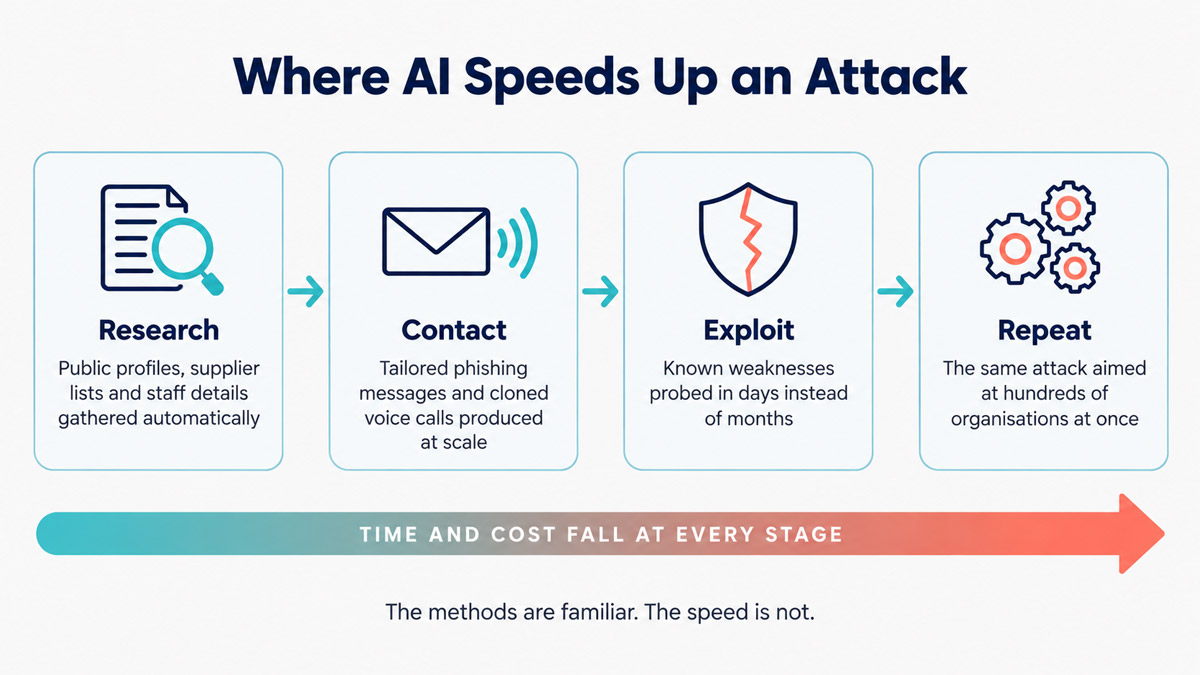
A cyber attack does not have to become more technically sophisticated to become more dangerous. If artificial intelligence can research a target, write a convincing message and automate the repetitive steps in between, the same attack can be launched faster and against far more organisations.
The UK government has said as much directly. An open letter to business leaders in April 2026, from the Secretary of State for Science, Innovation and Technology and the Security Minister, warned that a new generation of AI models can do work that once required rare expertise: finding weaknesses in software and writing the code to exploit them, at a speed and scale that was not possible a year earlier. The NCSC’s own assessment judges that AI will almost certainly make intrusion operations more effective and efficient, increasing the frequency and intensity of attacks.
Why AI Is Changing the Cybersecurity Equation
AI is increasing speed, scale and automation on both sides of the fight. Attackers can assist or automate work that once demanded substantial manual effort; defenders can process more security data, flag unusual behaviour and shorten investigations. Those gains are not arriving evenly, and the NCSC expects a widening divide between organisations whose defences keep pace and the larger group that falls behind.
The result is not that every attack becomes sophisticated overnight. It is that familiar attacks become cheaper, faster and easier to repeat, which matters most for organisations carrying weaknesses they already know about.
How AI-Powered Attacks Are Changing the Threat Landscape
More convincing phishing and social engineering
Phishing has never depended entirely on technical tricks. It succeeds when a message looks believable enough to persuade someone to click, open a file or move money.
Generative AI makes those messages quicker to produce and easier to tailor using information that is already public: a LinkedIn announcement, a supplier named on a website, a leadership change in the trade press. Voice cloning extends the same problem to phone calls and verbal approvals.
Employees can no longer treat spelling mistakes and awkward phrasing as the main warning sign. Context matters more: an unusual request, an unexpected change of bank details, pressure to bypass a normal process. The 2025 attacks on several major UK retailers were a reminder that the target is often a human procedure rather than a technical control, with attackers reportedly persuading IT help desks to reset credentials.
Faster vulnerability discovery and exploitation
AI can help attackers analyse software, identify weaknesses and adapt existing techniques. The consequence is a shrinking gap between a vulnerability becoming known and someone attempting to exploit it. For organisations with slow patching or unsupported systems, that turns a tolerable risk into an urgent one: a weakness that might once have gone unnoticed for months can be probed within days.
A lower barrier to entry
AI also handles the repetitive parts of an attack and reduces the expertise needed to attempt one at all. That matters most for smaller organisations without dedicated security staff: opportunistic attempts increasingly reach businesses that were never a deliberate target, but simply had an exposed service or an unpatched system.
AI Is Also Creating New Risks Inside Businesses
The threat is not only external. Businesses create fresh exposure whenever AI tools enter everyday work without clear controls.
Shadow AI
Employees use online AI services to summarise documents, analyse data or write code without involving IT. This is rarely recklessness; it is usually convenience under deadline pressure, and it mirrors the broader pattern in how AI is reshaping everyday work in UK organisations, where adoption has run ahead of policy.
The risk is lost visibility: what is being entered, where it is processed and whether the service is approved for business use. A workable policy names the permitted tools, the data that must never be pasted into them and the uses that need sign-off. Blocking everything without offering an alternative simply moves the activity onto personal accounts, where nobody can see it at all.
Generated code and content
Generated code can contain vulnerabilities and unsafe assumptions, and generated content can be confidently wrong. Speed does not remove the need for testing, review and approval; if anything, more first drafts arriving means review capacity becomes the bottleneck.
AI access to company data
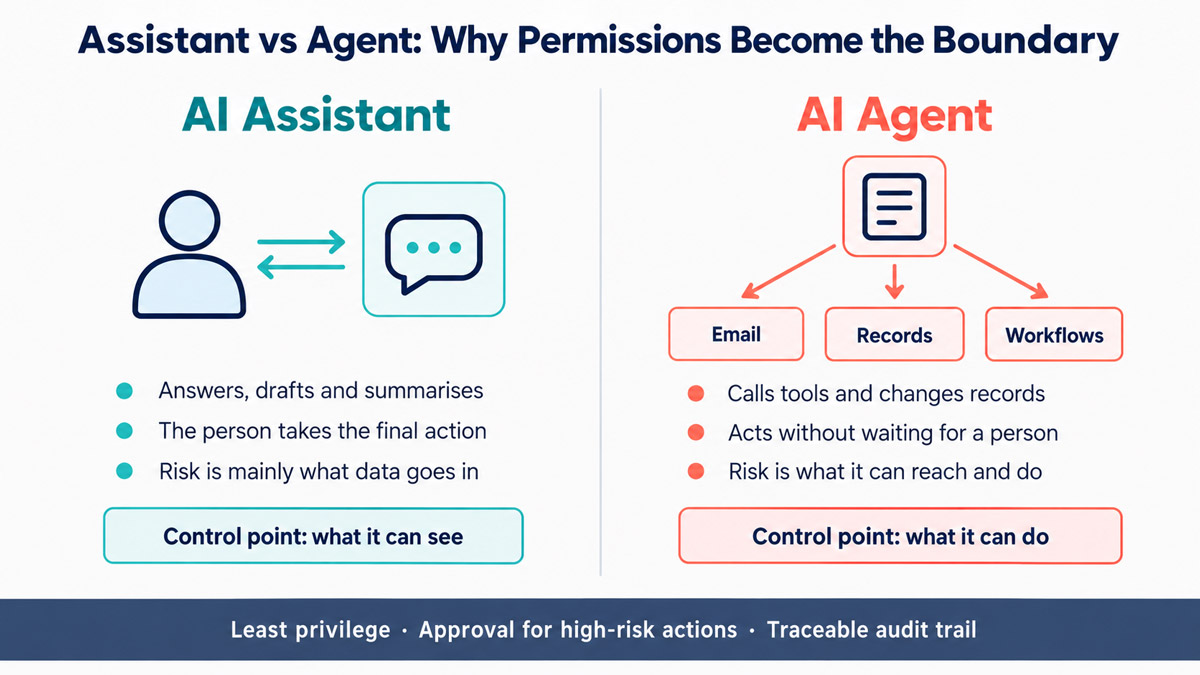
An assistant becomes a different kind of problem once it can reach internal documents, email, customer records or ticketing systems. Permission to access information is not the same as using it appropriately. Map what each tool can reach, why it needs that access, and what happens if its output surfaces something in front of the wrong person.
Agents raise the stakes
A chatbot answers. An agent acts, calling APIs, changing records and triggering workflows. The difference between AI assistants and AI agents is a governance question as much as a technical one, because permissions become the security boundary. Agents should run on least privilege, higher-risk actions should require approval, and every consequential action should be traceable. An agent with too much access can move across systems faster than a person can notice, let alone intervene.
How Businesses Are Using AI to Strengthen Defence
The same capabilities help defenders, particularly where teams face more data and alerts than people can reasonably process. AI can compare activity across users, devices and systems against normal patterns, search large volumes of log and telemetry data for indicators of compromise, and help decide which vulnerabilities to fix first based on real exposure rather than severity score alone.
Triage is where most teams feel the difference. Analysts often spend longer gathering context from separate systems than deciding what an alert means, and AI can correlate signals, summarise findings and rank cases. The benefit is not fewer alerts; it is less repetitive work, so experienced people spend their time on the cases that need judgement.
Some tools go further and recommend or perform actions such as isolating a device. Automation earns its place when seconds matter, but the more disruptive the action, the more important approval rules and audit trails become.
What AI Does Not Replace
It is tempting to assume AI makes traditional controls less important. The opposite is true, because faster attacks exploit basic weaknesses more quickly. AI does not remove vulnerabilities; patching does. Multi-factor authentication and least privilege still limit what a compromised account can reach, and help-desk verification belongs in that category too. Tested restores decide how long an incident lasts, and clear ownership decides how well an organisation copes under pressure.
What UK Businesses Should Do Now
- Fix the fundamentals first. Reduce internet-facing exposure, patch quickly, strengthen authentication, remove unnecessary permissions and deal with unsupported legacy technology. Cyber Essentials remains the most practical benchmark for smaller organisations.
- Set clear rules for business use of AI. Define approved tools, prohibited data and the situations that require security or management review.
- Review AI-connected permissions. Identify which applications, assistants and agents can reach sensitive information, and cut access wherever it is not necessary.
- Automate repetitive security work where it improves monitoring, triage or response without creating unacceptable risk.
- Test the response plan. Assume an attack gets through. Rehearse containment, recovery and communication, including who speaks to customers and regulators.
- Put cyber risk on the board agenda. The government’s Cyber Governance Code of Practice exists for this, and the NCSC’s free Early Warning service is a low-effort place to start.
A Practical Priority Guide
| Business type | Priority areas |
|---|---|
| Small business | Multi-factor authentication, patching, backups, secure configuration, Cyber Essentials and controlled AI use |
| Growing business | Endpoint protection, identity governance, central logging, AI usage policies and third-party risk controls |
| Enterprise | AI-specific access controls, agent permissions, detailed monitoring, security integrations and continuous testing |
The principle holds at every size: invest first in the controls that reduce the biggest risks, rather than buying AI security tools because they are new.
Conclusion
Both offensive and defensive activity will keep becoming more automated, which makes cybersecurity a resilience issue rather than a technical one. Boards need to know not only whether controls exist, but whether they hold up against faster attacks and how quickly the organisation recovers when something gets through.
The answer is not to chase every new security product. Fix the basic weaknesses, understand what AI tools can access, control how employees use them, and automate security work where it genuinely improves speed or visibility.
FAQs
How is AI making cyber attacks more dangerous?
AI helps attackers automate research, produce convincing social engineering content, find weaknesses and repeat attacks at scale. The change is mainly one of speed and cost rather than entirely new attack methods.
Can AI replace cybersecurity teams or traditional controls?
No. It can automate parts of detection, investigation and response, but complex cases, risk decisions and high-impact actions still need human judgement. Patching, multi-factor authentication, access control, backups and incident response remain essential.
What are the biggest AI security risks for small UK businesses?
Convincing phishing and voice impersonation, faster exploitation of unpatched systems, uncontrolled employee use of AI services, excessive tool permissions and weak basic controls.
Are AI agents a cybersecurity risk?
They can be. Because agents access data and take actions across multiple systems, they need least-privilege permissions, monitoring, approval controls for consequential actions and a reliable audit trail.
